
How to Authenticate a Louis Vuitton Cashmere, Wool & Winter Scarf: The Complete Guide
A Louis Vuitton winter scarf should never be authenticated from a logo alone. Cashmere, wool and winter scarves can differ significantly in construction, composition, labeling and finishing. The most reliable approach is to examine the entire object and compare several independent details rather than relying on one supposed “tell.”
- Start With the Whole Scarf
- Examine the Material
- How to Examine Cashmere
- How to Examine Wool
- Study the Weave or Knit
- Study the Monogram and Pattern Construction
- Examine the Fringe and Edges
- Read the Main Label Carefully
- Examine the Composition and Care Information
- Do Not Authenticate by Country Alone
- Check the Reference or Model Number
- Check Dimensions
- Vintage Scarves Need Historical Context
- Condition Is Not an Authenticity Test
- Common Red Flags
- The Complete Checklist
1. Start With the Whole Scarf
Before looking at the label, step back and examine the scarf as a complete piece. Look at its proportions, material, pattern, construction, edges, fringe, label placement and overall finish.
This matters because an individual detail can be copied. A counterfeit scarf may reproduce a familiar Louis Vuitton label while getting the textile, construction or proportions wrong.
2. Examine the Material
Louis Vuitton winter scarves are not made from one universal fabric. Current examples include 100% cashmere, 100% wool and wool-cashmere blends. That means the first question should be: Does the physical material make sense for the stated composition?
A scarf labeled as 100% cashmere should have the visual and tactile qualities expected from a fine cashmere textile. A wool scarf should be assessed as wool, while a blend should be considered according to its stated composition.
Do not make a final authenticity decision simply because a scarf feels soft. Modern synthetic fibers can also feel soft, and genuine pre-owned cashmere may have some pilling or surface wear.

3. How to Examine Cashmere
Cashmere scarves can have a soft, warm and fine surface, but softness alone does not establish authenticity. Look at the density and consistency of the textile, the way the fibers behave, the construction of the scarf and the condition of the surface.
Some genuine pre-owned cashmere scarves develop pilling through use. Therefore, pilling should not automatically be interpreted as evidence of a counterfeit. Instead, examine whether the surface, construction and label information remain consistent with the claimed material.
“It feels like cashmere” is not an authentication test. Material feel is evidence, but it should be combined with construction, label and model information.
4. How to Examine Wool
Louis Vuitton wool scarves can use woven, knitted or jacquard constructions. Current official examples include 100% wool scarves with Monogram or Damier patterns and fringed finishes.
Examine the surface under good lighting. Look for consistent yarn behavior, clean pattern formation and an overall construction appropriate to the design.
A vintage wool scarf should not necessarily look like a current Louis Vuitton scarf. The construction, label style and design language may belong to a completely different production period.

5. Study the Weave or Knit
Winter scarves may communicate their design through printing, weaving, knitting, jacquard construction, embroidery or combinations of techniques. This is one of the major differences between authenticating a silk square and authenticating a winter scarf.
If the design is woven into the textile, inspect the reverse side as well as the front. Ask whether the pattern appears integrated into the fabric rather than behaving like a poorly applied surface graphic.
Jacquard designs can create visual differences between the front and reverse of a scarf. A current Louis Vuitton Monogram Heritage scarf, for example, is officially described as a Monogram jacquard with a solid reverse.
6. Study the Monogram and Pattern Construction
Do not simply ask whether the scarf contains an LV or Monogram motif. Counterfeit products can reproduce recognizable motifs. Instead, examine how the design is constructed.
- Are the repeated motifs consistent?
- Are the borders proportionate?
- Does the pattern align logically with the construction?
- Does the reverse side behave as expected for a woven or knitted design?
- Are signatures integrated into the textile in a convincing way?
- Does the overall design correspond to a documented model?
Current official Louis Vuitton examples demonstrate that winter designs can use very different techniques. Some use jacquard Monogram, some use Damier constructions, and others use blended materials with dimensional textile effects.

7. Examine the Fringe and Edges
Fringe is an important construction detail on many Louis Vuitton winter scarves. Current official examples describe twisted fringe, fringed hems and other finished edges depending on the design.
Examine the fringe for consistency. Individual fibers may show normal wear, especially on pre-owned scarves, but the overall construction should make sense for the piece.
Do not assume that every Louis Vuitton scarf must have the same edge finish. A cashmere scarf, wool jacquard scarf and knitted scarf can have completely different finishing techniques.

8. Read the Main Label Carefully
The label is one of the most useful areas to examine because it can contain several pieces of information at once: the Louis Vuitton name, material composition, care instructions, country of manufacture and, depending on the product and period, reference or model information.
When examining a pre-owned scarf, photograph the label clearly before making any conclusions. Look at the lettering, spacing, stitching, material and the relationship between the label and the scarf itself.

Look at the Label as a Whole
Do not focus only on the Louis Vuitton name. Examine the complete label and compare all of its information with the physical scarf.
- Brand name and typography
- Material composition
- Care instructions
- Country of manufacture
- Reference or model information where applicable
- Label dimensions and proportions
- Stitching and attachment
- Position of the label on the scarf

9. Examine the Composition and Care Information
Material information is particularly important for winter scarves. A scarf described as cashmere should be evaluated against its stated composition, while wool and blended materials should be assessed according to their own construction.
Photograph the composition and care information clearly. If the scarf has more than one tag, photograph each tag rather than relying on a single image.

10. Do Not Authenticate by Country Alone
Country-of-manufacture information is useful, but it should never be treated as a stand-alone authenticity test.
Louis Vuitton production locations vary according to product category and period. Therefore, a country marking should be evaluated together with the material, construction, model, label and other evidence.

Does the stated country of manufacture make sense for this particular Louis Vuitton model, material and production period?
11. Check the Reference or Model Number
If a reference or model number is present, use it as a research clue rather than treating it as automatic proof of authenticity.
Compare the number against the actual scarf's material, dimensions, construction, colorway and design.

12. Check Dimensions
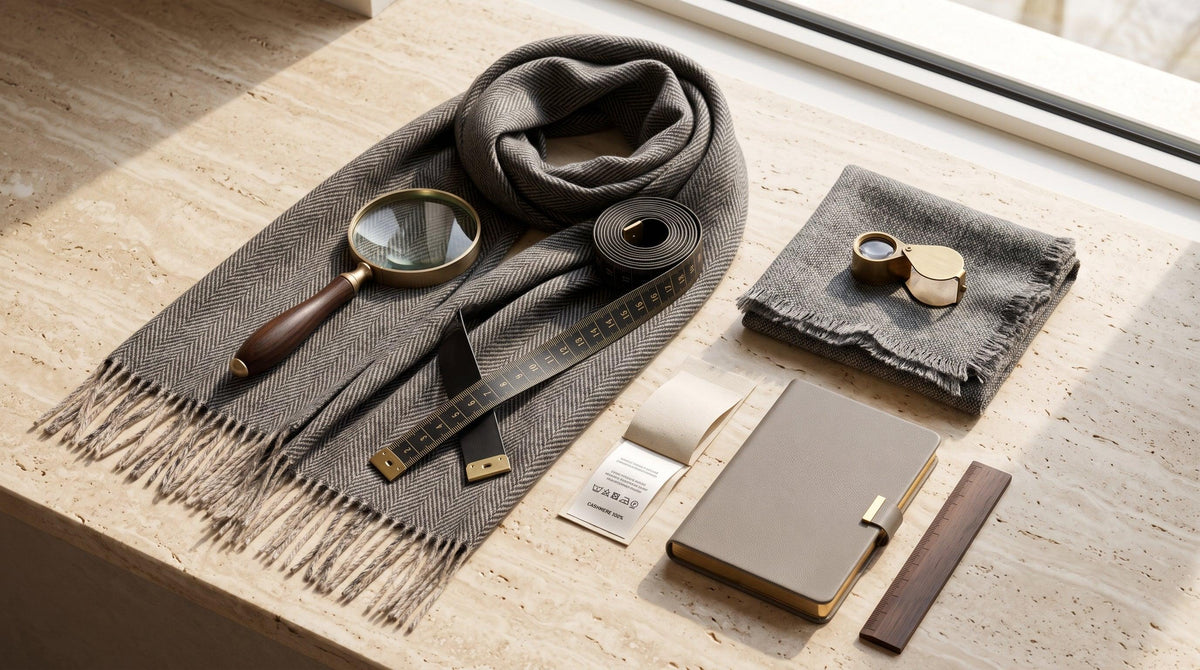
Measure the scarf rather than relying on an approximate seller description. Record its length and width, and where relevant, the fringe length.
Dimensions can help distinguish between different Louis Vuitton models and can expose inconsistencies when a supposed reference number corresponds to a substantially different design.
Measurements should still be interpreted carefully because textiles can stretch, shrink or change slightly with use and storage.

13. Vintage Louis Vuitton Scarves Need Historical Context
A vintage Louis Vuitton scarf should not be judged against a current scarf simply because both carry the same brand name.
Labels, materials, designs, construction techniques and production practices can change over time. An older scarf may therefore look very different from a current collection piece while still being legitimate.
This is especially important when examining older winter scarves. Research should begin with the scarf's apparent period, then move toward finding comparable examples from that period.

14. Condition Is Not an Authenticity Test
A genuine pre-owned cashmere or wool scarf can show pilling, pulled fibers, stains, fading, fringe wear or other signs of use.
Likewise, a counterfeit scarf can be in excellent condition.
Condition should therefore be documented separately from authenticity. Wear tells you about the scarf's history and current state; it does not by itself establish whether the scarf is genuine.
15. Common Red Flags
None of the following automatically proves that a scarf is counterfeit. They are reasons to stop and investigate further.
- Material stated on the label does not match the physical textile.
- Label information conflicts with the supposed model.
- Reference number points to a substantially different product.
- Dimensions are inconsistent with documented examples.
- Pattern construction looks inconsistent with the claimed technique.
- Fringe or edge construction is unusually poor.
- Label lettering or spacing appears poorly executed.
- Country-of-origin information conflicts with credible model evidence.
- The seller's story conflicts with the physical evidence.
- Multiple independent details fail to agree with one another.
The Complete Louis Vuitton Winter Scarf Authentication Checklist
- ☐ Examine the entire scarf before the label.
- ☐ Identify the claimed material.
- ☐ Examine cashmere, wool or blend texture.
- ☐ Inspect the weave, knit or jacquard construction.
- ☐ Examine the Monogram, Damier or other pattern construction.
- ☐ Inspect the reverse side where relevant.
- ☐ Examine the fringe and edges.
- ☐ Photograph and inspect the main label.
- ☐ Check composition and care information.
- ☐ Check country-of-manufacture information.
- ☐ Research any reference/model number.
- ☐ Measure the scarf.
- ☐ Compare the design with reliable examples.
- ☐ Consider the historical period.
- ☐ Separate condition from authenticity.
- ☐ Look for agreement between multiple independent details.
The Samr Authentication Principle
Authenticating a pre-owned Louis Vuitton scarf is a process of evidence gathering. Material, construction, label, dimensions, pattern, origin and historical context should tell a coherent story.
The label is evidence. The material is evidence. The model number is evidence. The country marking is evidence. None of these should automatically become the verdict on its own.
For silk scarves, continue with our companion guide: How to Authenticate a Louis Vuitton Silk Scarf .